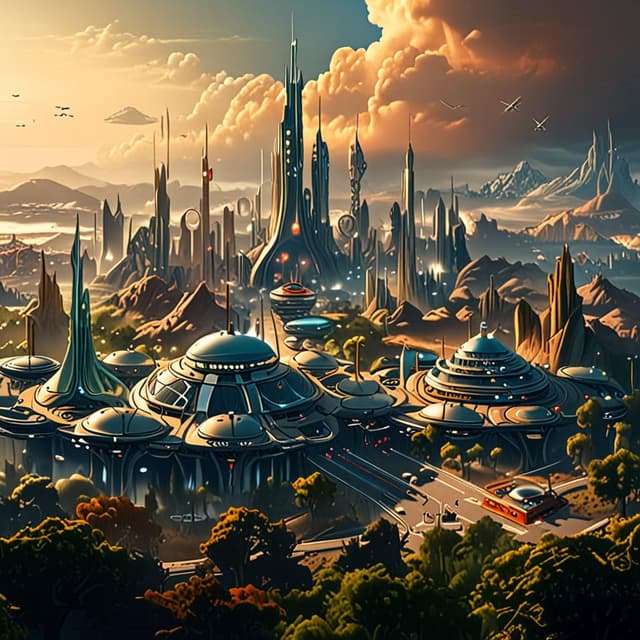
| Name | Tomorrowland |
| Type | Private city-state |
| Status | Major driver of scientific advancement and a symbol of humanity's aspirations for a better tomorrow |
| Founded | 1920s |
| Purpose | Utopian community dedicated to technological progress and human betterment |
| Founders | Group of visionary futurists, scientists, and inventors |
| Controversies | Secretive governance • Ties to the US government • Single-minded pursuit of technological supremacy • Ethical questions |
| Notable Achievements | Groundbreaking innovations in aerospace, computing, materials science, and renewable energy • Shaping and modernizing the world through its technological advancements |
Tomorrowland is a private city-state and technological hub located in the United States. Founded in the 1920s by a collective of pioneering futurists, scientists, and inventors, Tomorrowland has since become one of the most influential and controversial centers of innovation and progress in the world.
The origins of Tomorrowland can be traced back to the 1920s and the American Renaissance, a period of rapid technological, scientific, and cultural advancement in the United States. A group of visionary thinkers, including Nikola Tesla, Robert Goddard, Fritz Lang, and H.G. Wells, came together with the goal of creating a utopian community dedicated to the betterment of humanity through the power of technology.
In 1923, this group purchased a large tract of land in the American Southwest and began construction on their ambitious project. Guided by principles of transhumanism, technocracy, and social engineering, they envisioned Tomorrowland as a self-sustaining city-state where the brightest minds could collaborate free from the constraints of the outside world.
Over the following decades, Tomorrowland rapidly grew into a sprawling metropolis unlike any other. Its architecture, infrastructure, and urban planning were all designed to maximize efficiency, sustainability, and the seamless integration of technology into daily life. Advanced public transit, automated factories, and centralized data networks were just a few of the innovations that set Tomorrowland apart.
The city became renowned for its groundbreaking research and development in fields such as aerospace, computing, materials science, and renewable energy. Tomorrowland's laboratories and think tanks produced a constant stream of new technologies, many of which were then shared with the outside world to modernize and transform global industries.
Residents of Tomorrowland, known as "Tomorrowlanders," enjoyed a high quality of life with ample access to cutting-edge healthcare, educational opportunities, and cultural amenities. The community fostered a distinct ethos of rationality, collectivism, and technophilia that set it apart from the rest of the country.
Tomorrowland operates as a self-governing city-state with a complex political structure. At the top is the Directorate, a council of the most eminent scientists, engineers, and futurists who collectively guide the city's development and decision-making.
While nominally independent, Tomorrowland maintains extremely close ties to the United States government, providing it with advanced technologies, scientific expertise, and even military capabilities in exchange for funding, resources, and protection. This relationship has made the city-state an influential force in shaping American (and by extension, global) policy on issues ranging from space exploration to environmental regulation.
Tomorrowlanders, who make up less than 0.1% of the US population, wield an outsized degree of political and economic power. Critics have accused the city of being an undemocratic technocracy, while supporters argue that its meritocratic model is essential for driving rapid progress.
Tomorrowland's single-minded pursuit of technological supremacy has made it a source of both admiration and controversy over the decades. Supporters praise its many pioneering innovations that have transformed the modern world, from the first manned spaceflight to breakthrough medical treatments.
However, critics argue that Tomorrowland's secretive governance, ties to the military-industrial complex, and disregard for traditional social and ethical norms have made it a dangerous force. Environmental damage, labor exploitation, and the development of powerful surveillance and control technologies are among the city's most serious alleged transgressions.
Despite these controversies, Tomorrowland's influence and prestige only continue to grow. It remains a powerful engine of scientific and technological progress, shaping the future in ways both inspiring and unsettling. As humanity hurtles towards an uncertain tomorrow, the legacy and ultimate impact of this unique city-state remains to be seen.
